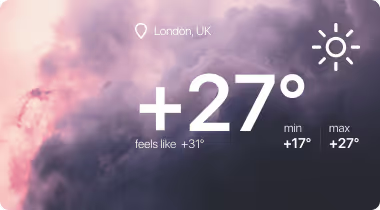
weather info updated every
15 minutes
Weather API and Forecast Solutions
MeteoFlow provides a weather forecast API and data solutions for businesses – structured access to real-time conditions, forecasts, and historical records through a direct integration.
Try nowWhat Is MeteoFlow Weather API and Who It's For
Every day, companies in agriculture, logistics, and energy make operational calls where weather is one of the deciding factors. Rerouting a truck, delaying a pour, holding a harvest - these decisions happen faster and with less exposure when the underlying data is reliable and location-specific.
MeteoFlow Weather API gives businesses direct access to that data. Current conditions, multi-day forecasts, severe weather alerts, and 20 years of historical records - all available through a single integration point. The API is built for teams that need weather embedded into their own systems, not pulled manually from a public forecast page.
Coverage spans more than 50 industries. The companies using it tend to share one characteristic: weather affects their operations regularly enough that checking a general forecast stopped being sufficient.
forecasts for your region with accuracy up to
4 km
10,000
available weather stations worldwide
Localized data
The station network covers over 10,000 locations worldwide. Forecast resolution reaches 4 km - field-level and site-level specificity rather than city or district averages. The weather data API also pulls from 20 years of historical records, which gives businesses enough depth to model seasonal patterns and validate predictive logic against real baselines.
Request consultationForecast Accuracy, Coverage, and Key Metrics
98% forecast accuracy is the headline number. What it means operationally: businesses can build automated triggers around the data - thresholds that fire alerts, adjust schedules, or reroute resources - without a manual check layer on top.
Data refreshes every 15 minutes. For a logistics platform or an energy management system, that cadence matters more than daily accuracy figures. Conditions shift faster than most general forecasts update, and the gap between a stale reading and a current one is where operational risk sits.
Trend projection from historical data reaches 85% accuracy. For planning cycles that extend weeks or months ahead, that figure determines whether weather becomes an input into the forecast or stays a variable that gets managed reactively.
What Data Businesses Get Through the API
Different industries draw on different parts of the same dataset. A construction company watches wind speed and precipitation. An energy provider tracks cloud cover and temperature differentials. A retailer pulls short-range forecasts to adjust staffing ahead of footfall changes. The weather data API returns the full parameter set - each business maps the relevant slice into its own workflow.
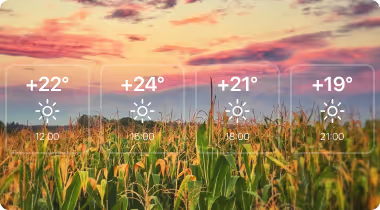
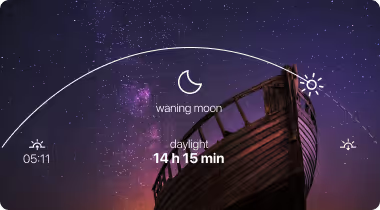
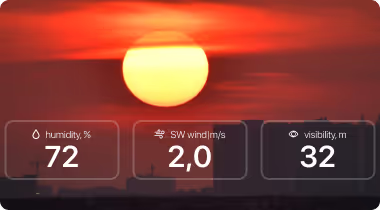
Parameters include temperature, feels like, humidity, wind speed and direction, visibility, atmospheric pressure, precipitation, and air quality index. Current conditions, multi-day forecasts, and historical records are all accessible through the same endpoint.
Data arrives in structured format, ready to feed directly into dashboards, planning tools, or automated decision systems without additional processing on the receiving end.
API Integration and Real-Time Delivery
Each connected system gets an update the moment conditions shift at its assigned coordinates. A business system set up this way receives a trigger - rather than querying the real-time weather API on a schedule and checking whether anything changed since the last call.
MeteoFlow supports REST and gRPC protocols, both of which fit standard development environments - so weather API integration slots into existing infrastructure without restructuring how data moves through a system. Most configurations are live in under a day. Documentation covers both protocols, and direct support is available throughout onboarding.
How Businesses Use MeteoFlow Weather Data
Agricultural operations use 4 km resolution forecasts to time irrigation and anticipate frost at the field level. A district-wide reading misses the variation that matters when plots sit at different elevations or exposures.
Logistics companies build weather API triggers into dispatch systems. When visibility drops below a threshold or wind forecasts exceed safe operating limits, rerouting happens automatically rather than after a dispatcher catches the change manually.
Energy providers track wind speed and cloud cover to project renewable output and balance load ahead of demand shifts. The forecast horizon matters here - a 7-day outlook feeds weekly generation planning in a way that a same-day reading cannot.
Retailers adjust staffing and inventory based on short-range forecasts. Footfall, outdoor seating decisions, and seasonal product demand all move with business weather data in ways that become predictable with enough forecast accuracy.
Construction sites receive severe weather alerts 2 days ahead. Crews and equipment get repositioned before conditions arrive rather than in response to them.
Business Impact of Accurate Weather Data
When forecast data is reliable enough to act on automatically, the decision-making layer changes. Conditions that previously required a manual check - or got missed entirely - become inputs into systems that respond without human intervention.
The operational effect shows up in two places. Planning efficiency improves because schedules, routes, and resource allocation can be set further in advance. Risk exposure drops because the gap between a weather event and an operational response narrows. Businesses integrating weather data API into core workflows report up to 30% reduction in operational risks and up to 20% improvement in planning efficiency.
For industries where a single weather event can disrupt output for days - a storm delaying a pour, a frost hitting a crop at the wrong stage, a wind spike taking wind turbines offline - the value of 15-minute data over a daily forecast is direct and measurable.
Business process integration
We offer seamless API integration that takes less than a day, making it easy for companies to quickly start using our data. Our platform supports both REST and GRPC protocols for maximum flexibility and performance. In addition, we provide tailored solutions for over 50 industries, allowing businesses to select the integration model that best aligns with their unique operational needs. Whether it's agriculture, logistics, or energy — our scalable weather intelligence can be adapted to any sector with minimal effort.
access to historical weather data
over 20 years
predict trends with up to
85%
Historical Data, Alerts, and Support
Twenty years of weather records lets businesses do something a real-time feed alone cannot: compare current conditions against long-term baselines and identify patterns that repeat across seasons. Agricultural planning, infrastructure risk assessment, and demand modeling all get more precise when the historical layer is deep enough to be statistically meaningful.
Try nowsupport for forecast integration
Rest API & GRPC
webhook
real-time weather updates by coordinates
Technology and integration
MeteoFlow Weather API is available for business integration now. Request a consultation to discuss data requirements and integration options for your industry.
Request consultationNotifications and warnings
Severe weather alerts fire up to 48 hours ahead. Storms, heavy rain, strong winds, and extreme temperatures are all covered. Alert configuration follows location and channel - notifications reach the systems and people that need them without requiring a monitoring layer on top of the weather API.
Customer support
Support runs 24/7. Business partners get a response within 30 minutes. For operations where a data disruption has direct consequences, that response window matters more than the support channel itself. Custom configurations are available for requirements outside the standard API setup.
FAQ
How often is weather data updated in the API?
Data refreshes every 15 minutes. Webhook delivery pushes updates to connected systems as conditions change at the specified coordinates, so the interval between a condition shift and a system response stays tight.
Can I get real-time weather updates through the API?
Webhook-based delivery means updates arrive as conditions change rather than on a polling schedule. The real-time weather API pushes data to connected systems by coordinates without requiring the receiving system to query for changes.
How long does it take to integrate a weather API?
Most standard configurations complete in under a day. MeteoFlow supports REST and gRPC, documentation covers both, and direct support is available throughout the weather API integration process.
Which industries use weather data APIs?
Agriculture, logistics, energy, construction, and retail are among the most common. The weather data API covers more than 50 industries - generally any sector where weather conditions feed into operational planning, risk management, or automated decision systems.


