Facts About the Water Cycle
The same water that fell as rain during the Jurassic period is still cycling through Earth's atmosphere, oceans, and land today. Not a drop has been added or lost in over three billion years. These facts about the water cycle explain how that continuous redistribution works – and why it drives every weather event on the planet.
The water cycle facts covered here include how water is distributed across Earth, how long it stays in each part of the system, and what happens when the cycle is disrupted.
What Is the Water Cycle: A Quick Overview
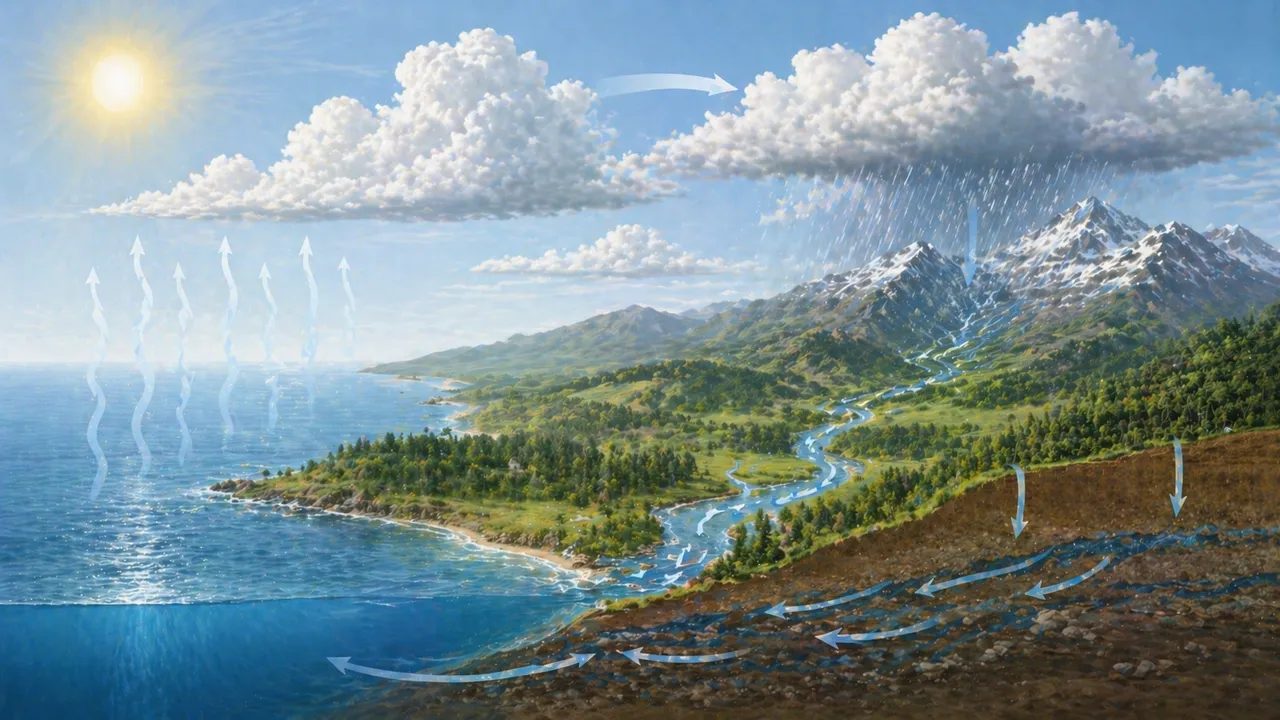
The water cycle moves water continuously between the ocean, atmosphere, land surface, and groundwater. Facts about water cycle stages show that the process has no fixed start – water entering any stage will eventually pass through all the others.
The Main Stages of the Water Cycle
Water leaves the ocean and land surface through evaporation, rising into the atmosphere as vapour. Once airborne, it cools, condenses into clouds, and eventually falls back as rain, snow, or hail. From there, some of it runs across the surface toward rivers and back to the sea. The rest moves downward through soil into groundwater below.
Transpiration from plants contributes around 10% of all moisture entering the atmosphere – making vegetation an active participant in the cycle rather than a passive recipient of rainfall.
What Powers the Water Cycle
Solar energy is the engine. Without it, evaporation stops and the entire cycle stalls. The sun evaporates roughly 502,800 km³ of water from Earth's surface every year – enough to cover the entire continental United States in a layer over 50 meters deep.
Gravity handles the return. Once water condenses and falls as precipitation, gravity drives it downslope through rivers and into the ocean, where the cycle continues.
Key Facts About the Water Cycle
The numbers behind the water cycle are among the most striking facts about the water cycle – they reveal a system operating at a scale that is difficult to visualize from ground level.
How Water Is Distributed on Earth
97.5% of all water on Earth is saltwater. The remaining 2.5% is freshwater – but around 69% of that is locked in glaciers and ice caps. Less than 1% of all Earth's water exists as accessible freshwater in rivers, lakes, and shallow groundwater.
Rivers – the source most people picture when they think of freshwater – hold just 0.006% of all water on Earth. That fraction supports a significant share of global drinking water, agriculture, and ecosystems.
How Long Water Stays in Each Part of the Cycle
Residence times vary by orders of magnitude. The atmosphere holds water for around 9 days before it falls as precipitation. Rivers cycle their water in 2 to 6 months. Deep ocean water circulates for up to 3,000 years before evaporating back into the atmosphere.
A single water molecule passes through the atmosphere and back to the surface roughly 40 times per year – cycling far faster than the ocean water it may have evaporated from.
The Role of Plants: Transpiration
The Amazon rainforest releases around 20 billion tonnes of water vapor into the atmosphere every day through transpiration. That volume is large enough to influence rainfall patterns across South America – the forest generates its own moisture supply and feeds it back into the regional weather system continuously.
Fun Facts About the Water Cycle
Some of the most fun facts about the water cycle sit outside standard explanations – in the details that reframe how familiar things actually work.
The Water You Drink Is Millions of Years Old
Water molecules are neither created nor destroyed in the cycle – they circulate indefinitely. Some water in deep aquifers has been dated to over 2 billion years old, predating complex life on Earth entirely.
The molecule of water in a glass on your desk may have passed through an ancient ocean, a glacier, a dinosaur, and a rainstorm before reaching you. The cycle does not distinguish between old and new water – it moves all of it continuously.
Only a Fraction of Earth's Water Is in the Atmosphere
Atmospheric water represents just 0.001% of all water on Earth. If every water molecule currently in the atmosphere fell simultaneously, the resulting rain would cover the entire planet in approximately 2.5 centimeters.
That thin layer drives every storm, flood, and drought on Earth. The fun facts about water cycle do not get more counterintuitive than this: all weather begins with a fraction of water so small it would barely reach your ankle if spread across the ground.
The Water Cycle Has No Beginning or End
There is no point in the water cycle that functions as a start. Water entering the ocean will evaporate, condense, fall as precipitation, and return – but the sequence can be entered or exited at any stage.
The total volume of water on Earth has remained essentially constant for over 3 billion years. The same amount, continuously redistributed, with no net gain or loss.
Track precipitation and local weather patterns in your area with MeteoFlow.
How Climate Change Is Affecting the Water Cycle
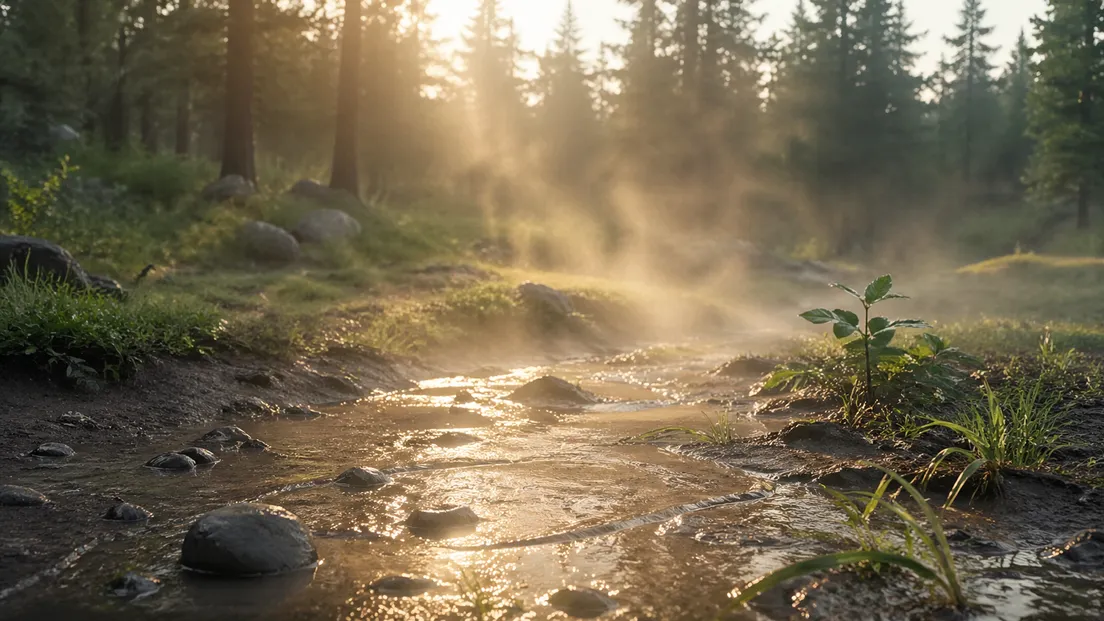
Warmer temperatures accelerate evaporation. More water enters the atmosphere faster, and a warmer atmosphere holds more of it – for every 1°C of warming, the atmosphere can retain roughly 7% more water vapor.
That extra moisture does not distribute evenly. Wet regions tend to receive heavier precipitation as the additional vapor condenses. Dry regions lose more water through evaporation without receiving proportionally more rain. The cycle intensifies at both ends – more extreme rainfall events in some areas, longer and deeper droughts in others.
Why the Water Cycle Matters for Weather and Climate
Evaporation does not just move water – it moves heat. When surface water vaporises, it carries thermal energy into the atmosphere. That energy releases when the vapor condenses into clouds, driving the wind systems and pressure differences that produce weather at every scale. Hurricanes are the most visible example: they intensify directly over warm ocean water because evaporation feeds their energy continuously from below.
Cloud cover shapes temperature at the surface. On a clear night, heat escapes rapidly upward. A cloudy one holds it back. The water cycle determines which condition prevails and for how long – it is the primary mechanism regulating how much solar energy the surface retains.
Agriculture, river systems, and groundwater all depend on where and when rainfall arrives. The cycle does not distribute water evenly – it concentrates it in some regions and withholds it from others, and those patterns define what is possible on the land beneath them.
Use MeteoFlow to monitor rainfall, drought conditions, and seasonal weather shifts in your region.
FAQ
How much of Earth's water is stored in glaciers?
Around 69% of all freshwater – roughly 26.35 million km³. Glaciers and ice caps hold more accessible fresh water than all rivers and lakes combined.
How long does a water molecule stay in the ocean?
Average residence time in the ocean is around 3,000 years. Deep ocean water circulates slowly before evaporating back into the atmosphere and re-entering the active cycle.
Does the water cycle ever stop?
No. As long as solar energy reaches Earth, evaporation continues. The cycle has operated without interruption for over 3 billion years.
What would happen if the water cycle stopped working?
Precipitation would cease within days. Freshwater supplies would collapse within weeks. Most terrestrial life would not survive beyond months without rainfall replenishing rivers and groundwater.
How does the water cycle affect weather patterns?
Evaporation and condensation distribute heat and moisture across the planet. Without the cycle, temperature extremes would be far more severe, storms would not form, and rainfall would not exist.
