How Are Rainbows Formed and What Causes Them?
A rainbow appears when sunlight passes through raindrops in the air. That is the short answer to how are rainbows formed. As light enters each drop, it bends, reflects inside, and then bends again as it leaves. Those three steps are what causes a rainbow to appear in the sky.
Together, these processes separate white sunlight into the visible colours of the rainbow. The sections below explain how that happens, why the colors spread out in a fixed order, and when rainbows are most likely to be seen.
What Causes a Rainbow
The basic answer to what causes a rainbow is simple: you need sunlight, raindrops, and the right viewing angle. A rainbow becomes visible when the Sun is behind the observer and rain or water droplets are in front. Without that alignment, the colored arc does not appear.
Each raindrop redirects light in a very specific way. As sunlight enters the drop, it bends, reflects inside, and bends again as it exits. That process sends different colors out at slightly different angles. This is why what causes rainbows is not just rain alone, but rain combined with sunlight returning at the right moment. That is also why rainbows often appear just after a shower.
How Does a Rainbow Form in the Sky
To answer how does a rainbow form, it helps to picture what happens inside a single drop of water. Sunlight enters the droplet and changes direction as it passes from air into water. Inside the drop, part of that light reflects from the inner surface. When the light leaves the droplet, it bends again and comes out at a new angle.
One droplet gives off only a tiny piece of the effect. The full arc appears because countless droplets are doing the same thing at once. Each one sends a narrow band of color toward the observer.
Why Do We See the Colours of the Rainbow
Sunlight may look white, but it actually contains many different wavelengths of light. When sunlight passes through raindrops, those wavelengths do not behave exactly the same way. Some bend a little more, others slightly less. This difference gradually separates the light as it moves through the droplet.
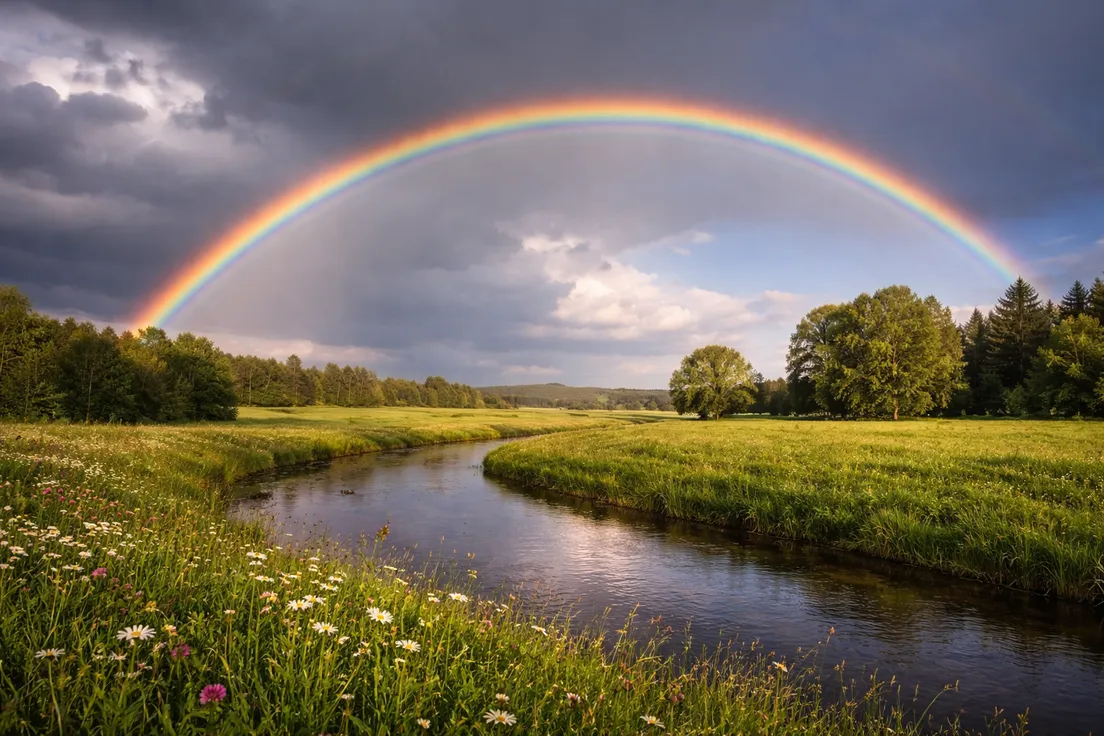
That separation is why we see the familiar colours of the rainbow. The arc usually begins with red along the outer edge and shifts through orange, yellow, green, and blue toward violet on the inner side. Each color leaves the raindrop at a slightly different angle. Because millions of droplets are doing this at the same time, the colors appear spread across the sky as a smooth curved band.
When and Where Rainbows Are Most Likely to Appear
Rainbows appear most easily when two conditions meet: sunlight and water droplets in the air. In many cases the Sun is fairly low in the sky while rain is still falling in the distance. The Sun remains behind the observer, and the droplets that produce the rainbow lie ahead.
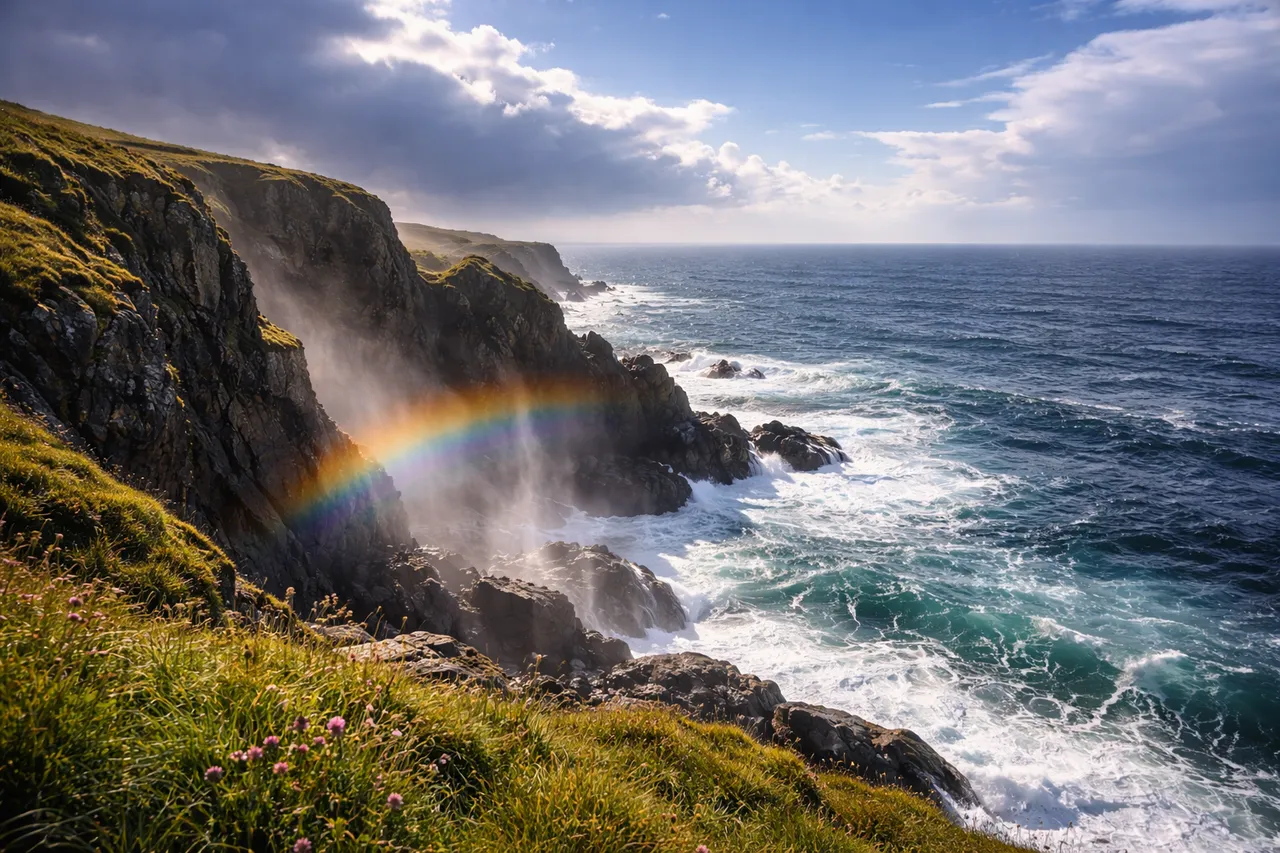
In practice, these conditions often happen just after a rain shower when sunlight breaks through clouds. Similar effects can appear near waterfalls, ocean spray, or even fine mist in the air.
Rainbow Facts and Common Myths
A few simple rainbow facts are worth remembering. Each observer sees their own rainbow because the exact angles depend on their position. If you move, the rainbow appears to move too. It also has no fixed physical location in the landscape.
That helps explain one of the oldest myths about rainbows: the idea of an end point you can reach. A rainbow is not an object hanging in one place. It is a visual effect created by light, water droplets, and the observer's point of view.
Explore real-time weather data and forecasts for your location on MeteoFlow.
FAQ
Can a rainbow form without rain?
Yes. Fine mist, waterfall spray, and sea spray can all create the same effect. What causes rainbows is not rain alone, but sunlight passing through tiny water droplets in the air.
Why does a rainbow have a curved shape?
The shape comes from the angles at which light leaves many raindrops. From the ground, that geometry usually appears as a curved arc.
Are there always seven colours of the rainbow?
Not exactly. The visible spectrum is continuous, but the colours of the rainbow are traditionally named as seven for simplicity.
What is a double rainbow and how does it form?
A double rainbow appears when light reflects twice inside raindrops instead of once. The second arc is usually fainter and has its colors reversed.
Why can't you reach the end of a rainbow?
Because the rainbow changes with your position. As you move, the viewing angle changes too, so the rainbow never stays fixed at one point on the ground.
