What Is the Difference Between Humidity and Relative Humidity?
The weather app shows 74%. Is that how much water is in the air, or something else? Most people use the word humidity loosely – but humidity vs relative humidity are two distinct measurements. What does humidity percentage mean in a forecast is a specific, answerable question, and understanding the distinction makes weather data significantly easier to read.
What Is Humidity?
Humidity in its absolute form is the actual amount of water vapour present in the air – measured in grams per cubic metre or grams per kilogram. It tells you exactly how much moisture is physically there, and it does not change with temperature.
The difference between humidity and relative humidity starts here. Absolute humidity is a fixed quantity. It is used primarily in scientific and engineering contexts where precise moisture content matters – not in the forecasts most people check before leaving the house.
What Is Relative Humidity?
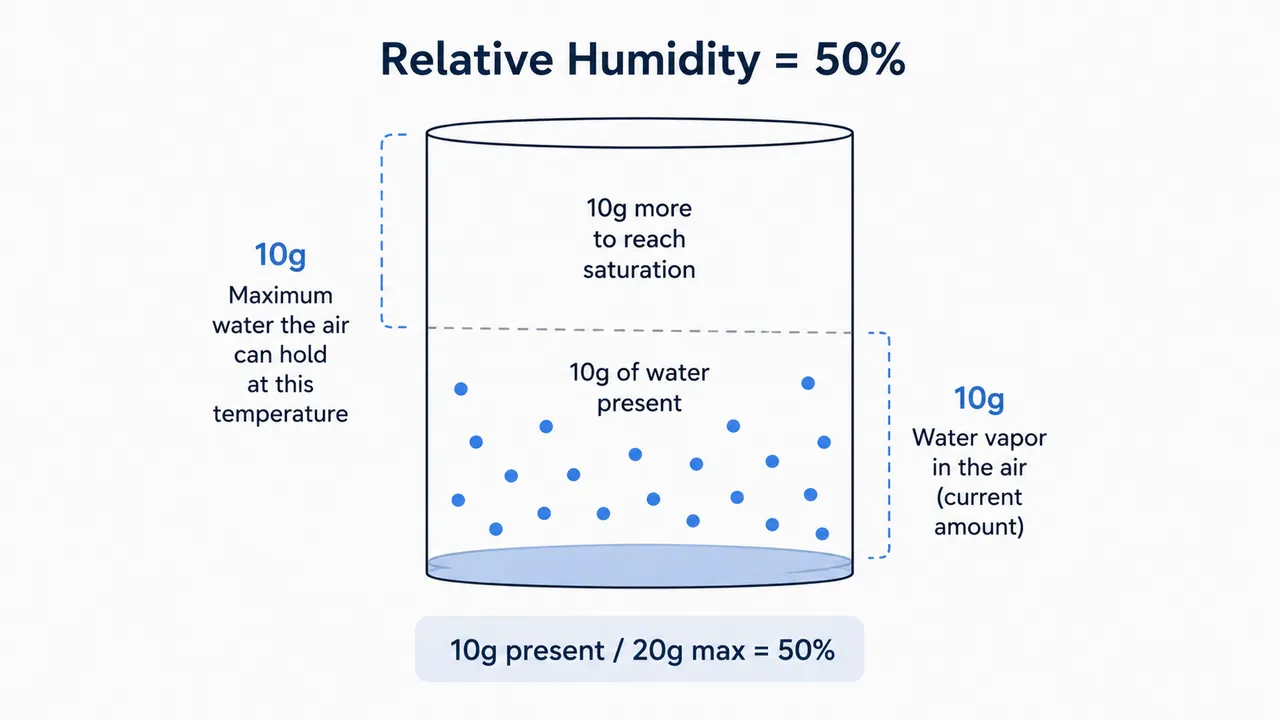
What is relative humidity? It is the percentage of water vapour currently in the air compared to the maximum amount that air could hold at that specific temperature.
If air contains 10 grams of water vapour and could hold a maximum of 20 grams at its current temperature, the relative humidity percentage meaning is 50%. The air is half-saturated. This is the figure shown in every weather forecast and app – not the absolute quantity of moisture, but how close the air is to its saturation point.
Why Relative Humidity Changes with Temperature
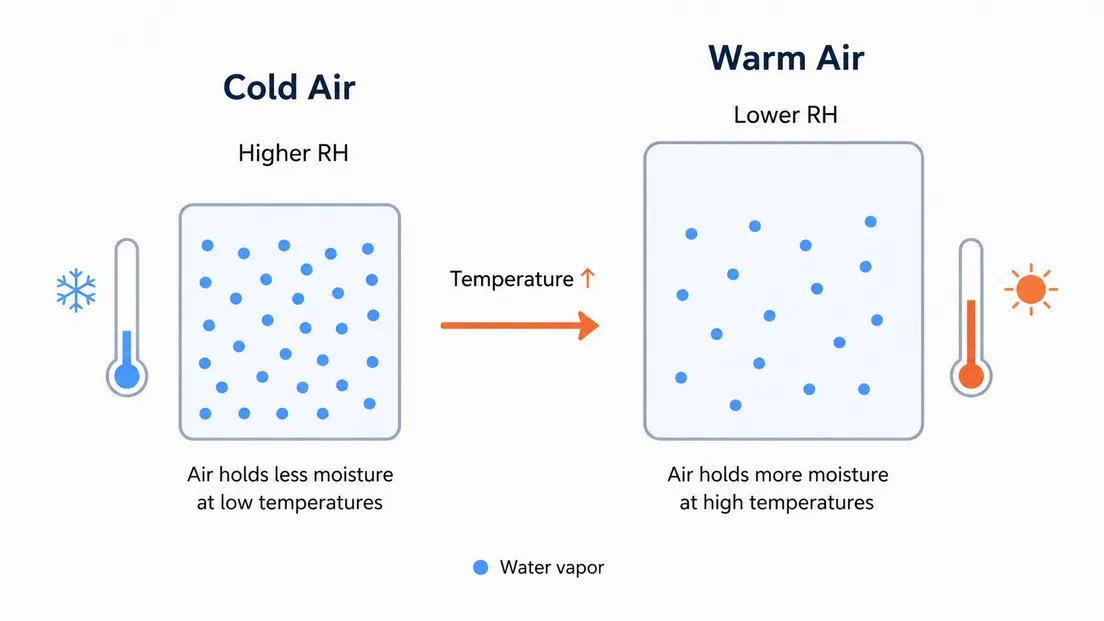
Why does humidity change with temperature throughout the day? Because warm air holds more water vapour than cold air. The same absolute amount of moisture produces a lower relative humidity reading at midday than at midnight – not because moisture was added or removed, but because the air's capacity changed.
This is why forecasts show humidity dropping as temperatures rise through the morning and climbing again as temperatures fall toward evening. The moisture content may stay constant throughout. Only the ratio changes.
Why the Difference Matters in Practice
Relative humidity directly affects how conditions feel and behave. Three areas where it has the most practical impact:
Comfort and the Feels-Like Effect
High relative humidity in summer slows sweat evaporation. The body cools itself through evaporation – when the air is already close to saturation, that process stalls. Heat feels more intense, fatigue sets in faster, and the feels-like temperature climbs above the actual reading.
In winter, heated indoor air often has very low relative humidity. The air can hold more moisture at higher temperatures, so the same absolute moisture content produces a lower RH – leaving skin, eyes, and airways feeling dry.
Weather Forecasting and Precipitation
When relative humidity reaches 100%, the air is fully saturated and can no longer hold additional vapour. Condensation begins. Clouds form, dew settles on surfaces, or fog develops at ground level. Rain follows when condensation accumulates enough mass to fall.
Relative humidity is one of the primary variables meteorologists monitor when forecasting precipitation. A reading approaching 100% in a cooling air mass is a reliable precursor to visible moisture in some form.
Industrial and Scientific Applications
Pharmaceutical manufacturing, food storage, and electronics production all require controlled relative humidity. In pharmaceutical facilities, moisture levels affect the stability and shelf life of products – a shift of a few percentage points can compromise an entire batch. The same principle applies wherever moisture-sensitive materials are stored or processed.
Check real-time humidity readings alongside temperature and precipitation forecasts for your location on MeteoFlow.
Which One Do Weather Forecasts Show?
The percentage shown in a weather app is always relative humidity. Humidity in weather forecast displays never show absolute moisture content – relative humidity is the figure that reflects how air actually feels and behaves at the current temperature.
Absolute humidity tells you how much water is in the air. Relative humidity tells you what that moisture means for conditions on the ground – whether fog is likely, whether sweat will evaporate, whether the air feels oppressive or dry. For everyday decisions, that context is what matters.
MeteoFlow presents relative humidity alongside temperature, precipitation probability, and feels-like readings in a single view – so the numbers are available together rather than requiring separate lookups to understand how conditions combine.
Read humidity and temperature data side by side for your exact location on MeteoFlow – before you step outside.
FAQ
Why does relative humidity feel uncomfortable at high levels?
High RH slows sweat evaporation, reducing the body's ability to cool itself. The air already holds significant moisture, leaving little capacity to absorb more from the skin.
Can relative humidity exceed 100%?
In practice, air can briefly become supersaturated under specific conditions – but in standard forecasting, 100% marks the saturation point where condensation begins. Fog, dew, and rain all result from air reaching this threshold.
Why is humidity higher at night than during the day?
Temperature drops at night, reducing how much moisture air can hold. The same absolute moisture content represents a higher relative humidity percentage meaning at lower temperatures – so RH rises even without any new moisture entering the air.
How does humidity affect weather forecasting accuracy?
Relative humidity is a key input for precipitation and fog forecasts. Errors in humidity measurement compound through forecast models, affecting the accuracy of rain probability, dew point, and feels-like temperature calculations.
