Why Is Delhi So Polluted?
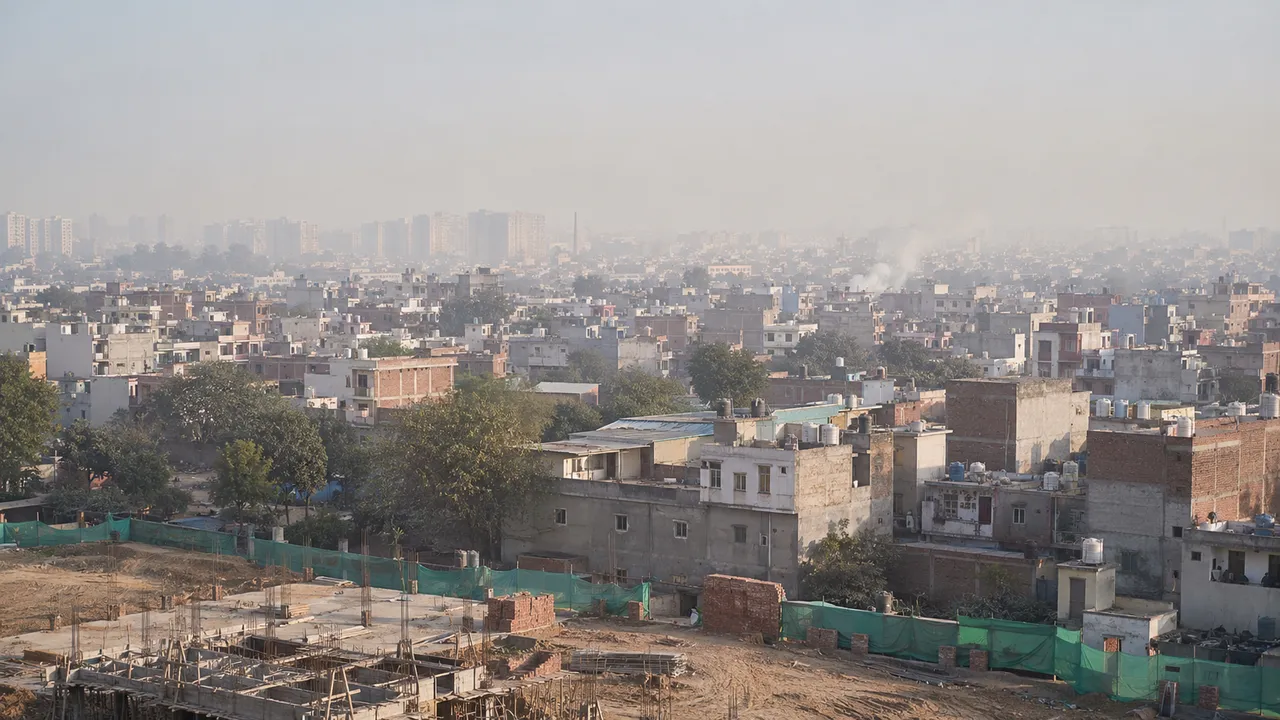
Delhi is so polluted because many factors overlap. A big and growing amount of emissions comes from traffic, dust, construction, fuel burning, waste burning and sources from places. Delhi's geography stops air from moving. Winter weather squeezes the air layer where these bad gases gather. No single cause can explain everything. The causes of air pollution in Delhi change in importance, with the seasons and weather.
Main Causes of Air Pollution in Delhi
Quantifying individual source contributions is contested. Delhi NCR source-apportionment studies produce different figures depending on the measurement method, season and geographic boundary used – the numbers below reflect that variability rather than a settled consensus.
Traffic Emissions and Road Dust
In 1998, India's Supreme Court ordered Delhi's entire bus and auto-rickshaw fleet to switch from diesel and petrol to CNG by 2001. The transition happened under legal penalty – Rs 1,000 per diesel bus per day for non-compliance. It remains one of the largest forced fuel conversions in any city's history, and it produced a measurable dip in vehicular PM2.5 for roughly two years after completion.
The fleet has grown considerably since. Of Delhi's 80 lakh registered vehicles, approximately 62 lakh are now classified as end-of-life under current rules – including 41 lakh two-wheelers. Two-wheelers are the category that matters most for PM2.5: their numbers are vast, older two-stroke engines emit around ten times the pollutants of newer four-stroke equivalents, and they concentrate in exactly the corridors where people walk and breathe at street level. Delhi's draft EV Policy 2.0 proposes banning new petrol and diesel two-wheeler registrations from August 2026. Whether that deadline holds is a separate question from what the fleet looks like today.
Construction, Industry, Generators and Waste Burning
Receptor model data for three days in January 2023 attributed 5-7% of Delhi's PM2.5 to coal combustion and 2-6% to open waste burning. Delhi's three major landfills – Bhalswa, Ghazipur and Okhla – burn periodically, releasing fine particles and gases into an atmosphere already carrying a heavy load from traffic and construction. Diesel generators add NOx and fine particles across the NCR wherever grid supply is interrupted.
Construction dust has no obvious seasonal respite. Delhi's urban expansion has been continuous since the 1990s, meaning demolition, excavation and unpaved site surfaces contribute to the PM10 baseline in every month of the year.
Crop-Residue Smoke and Other Regional Sources
Farmers in Punjab discovered that the satellites monitoring crop fires – MODIS and VIIRS – pass over between 10:30am and 1:30pm. By 2024, over 90% of large farm fires in Punjab were starting after 3pm, according to iFOREST analysis using Meteosat-8 and 9 data. Official fire counts showed a steep decline; actual burnt area fell at a much slower rate. The fire counts that Delhi's air quality debate has been built around are largely a measurement gap, not a real reduction.
When northwesterly winds carry that smoke toward Delhi in October and November, the timing matters: evening burning coincides with a shallow boundary layer and dropping temperatures – conditions that concentrate rather than disperse the incoming plume. The Commission for Air Quality Management estimates two-thirds of Delhi's PM2.5 originates outside its administrative boundary. Farm smoke is one component of that external load; regional power stations, industrial emissions and interstate diesel traffic flowing in on unfavourable wind patterns make up the rest.
How Delhi's Geography Traps Polluted Air
The Himalayas block northward dispersal of winter air; the Aravalli Hills interrupt flow from the southwest. Flat terrain fills the remaining flanks. One Delhi pollution reason that no policy directly addresses is this: the Indo-Gangetic Plain basin has no outlet that functions like a coastline or an open mountain pass. A University of Reading analysis from 2025 concluded that even hypothetically zero local emissions would not eliminate Delhi's winter air quality problem – the geography alone collects whatever the region produces.
Why Delhi Pollution Is High in Winter
Why Delhi pollution is high in December and January is not primarily a story about emissions increasing. Emission levels stay broadly stable across seasons. What changes is the atmosphere's capacity to disperse them.
Temperature Inversions and a Shallow Mixing Layer
On a winter night in Delhi, the ground loses heat rapidly through radiation. Cold air settles near the surface; a layer of warmer air above holds it down. Under normal conditions, surface air warms relative to the air above it and rises, carrying pollutants upward. The inversion reverses this completely. Pollutants emitted at street level have nowhere to go vertically.
The planetary boundary layer – the atmospheric zone directly influenced by the Earth's surface – compresses to its shallowest during winter nights, as documented in Journal of Geophysical Research: Atmospheres research from 2021. Mixing height, the altitude to which pollutants can actually disperse, drops sharply. Emissions that would dilute across hundreds of metres of atmosphere in July instead concentrate in a shallow layer where people are breathing.
Weak Winds, Fog and Secondary Particle Formation
December and January wind speeds in Delhi regularly fall below 2 metres per second. At those speeds, horizontal ventilation of the basin effectively stops. Gases from vehicles, industrial sources and burning sources then sit in the shallow layer long enough to react chemically and convert into secondary PM2.5 – fine particles formed in the atmosphere rather than emitted directly. CSE's late 2025 analysis found that most of Delhi's PM2.5 load is this secondary, chemically formed fraction.
High humidity at low temperatures produces fog. The fog absorbs and carries additional particulates, reduces incoming solar radiation, delays the warming that would eventually break the inversion, and extends poor conditions into the late morning. The characteristic dense smog of a Delhi January is fog, secondary particles and primary emissions combined in a layer that the atmosphere has no mechanism to flush until temperature and wind conditions change.
How Delhi's Air Quality Changes During the Rest of the Year

The same emission load produces very different AQI readings across seasons because the meteorological conditions governing dispersion change substantially through the year.
Pre-Monsoon Dust and Heat
March through May brings westerly winds carrying Thar Desert dust toward the city. PM10 rises, but higher temperatures lift the mixing height and improve dispersion. CSE data for 2024-25 shows April still recorded a 10% year-on-year PM2.5 increase – transitional conditions produce spikes without requiring the inversion mechanism.
Monsoon Rainfall and Temporary Air-Quality Improvement
The Southwest Monsoon arrives in late June or early July. Rainfall scrubs particles from the air; wind speeds increase; dust stays grounded. CSE's 2024-25 analysis records PM2.5 declines up to 27% in individual months across May, June, July and September. Annual PM2.5 fell 7% between 2023-24 and 2024-25 – progress that still leaves concentrations far above national ambient air quality standards.
October ends the improvement. Rainfall drops sharply, wind speeds fall, the boundary layer starts compressing again, and crop residue burning in Punjab and Haryana begins. The transition from monsoon to post-monsoon is the point at which Delhi's worst pollution season starts building.
How Weather Forecasts Help Explain Changes in Delhi's AQI
Wind speed, wind direction, rainfall, temperature and humidity drive Delhi's day-to-day AQI variation independently of any change in what the city emits. Checking the Delhi weather forecast shows when northwesterly winds are due – the meteorological signal that crop smoke may arrive – or when calm, humid conditions are setting up the inversion pattern that produces severe December smog.
Delhi has no single pollution source. Emissions from transport, dust, construction, fuel combustion, waste burning and surrounding regions create the load. Geography and weather determine whether that load disperses across the wider atmosphere or accumulates near the ground where it affects the people living in it.
FAQ
What is the difference between PM2.5 and PM10?
The number refers to diameter in micrometres. PM10 covers coarser material – road grit, construction dust, windblown soil – that the upper airways can filter. PM2.5 sits below 2.5 micrometres, reaches the bloodstream, and is the fraction epidemiological research consistently links to cardiovascular and respiratory disease. Most of Delhi's PM2.5 forms chemically in the atmosphere from combustion gases rather than arriving as ready-made particles.
How does outdoor air pollution affect indoor air quality in Delhi?
Without active filtration, indoor PM2.5 in Delhi tracks outdoor concentrations closely during severe episodes – Indian urban studies record indoor-outdoor ratios near 1.0 in poorly sealed buildings. Opening a window while running a HEPA purifier effectively cancels the purifier's work; the outdoor air volume entering the room exceeds what the device processes.
Do air purifiers help during severe pollution episodes in Delhi?
Sized correctly for the room with windows closed, a HEPA purifier cuts indoor PM2.5 meaningfully. HEPA media captures fine particles but not NO2 or ozone – those pass through without interception and require activated carbon to filter. The Clean Air Delivery Rate of the unit relative to room volume sets the ceiling on how much reduction is achievable.
Who is most sensitive to Delhi's polluted air?
Sensitivity to PM2.5 is not uniform across the population. Children's developing lungs absorb a proportionally higher dose than adults at the same ambient concentration. Older adults and people with existing heart or lung conditions face faster progression of symptoms at exposure levels that healthy adults tolerate. Pregnant women represent a third high-risk group, with research linking PM2.5 exposure to adverse birth outcomes. Among healthy adults, those who work outdoors near major roads or demolition sites often accumulate daily exposures well above what fixed monitoring stations record for the city overall.


